
#52
Opera Isn't Dying. The Business Model Is. Featuring Caitlin Vincent
Is opera actually dying, or is the business model simply stuck in the digital dark ages? In this episode of The Offstage Mic, Aubrey Bergauer sits down with Dr. Caitlin Vincent, author of 'Opera Wars', to dismantle the narrative that the art form is fading. Instead, they look at the hard data: while public demand for live culture remains high, the structural systems—from hiring practices to financial management—are faltering.
Transcript
[00:00:00] Hey, everyone. Welcome to episode three of this season of The Offstage Mic. If you've been following along this season, you know the theme is Changing the Narrative in 2026. What does it mean to change the narrative at our arts organizations today?
I want to begin today the way we've begun the last two episodes, which is by sharing some research. Today's research I want to share comes to us from a labor economist who studies the economics of art and culture. His name is Christos Makridis. He is an associate research professor at Arizona State University, as well as a digital fellow at Stanford University, and a senior researcher advisor at Gallup.
So you can imagine that when this came across my field, this intersection of economics and arts and culture, I perked up. What I'm about to share is all through the lens of opera today. But if you do not work in opera, I do not think this episode isn't for you. Just the opposite. If you care about big issues affecting our field. You should listen and I think or hope at least that you will definitely relate to this episode and probably see the parallels to your own artistic discipline, as well as learn a lot along the way.
So this researcher sought out, to quote, assess the state of opera in the US. In his words, he said, is it dying? Now what's so funny? Or I guess prescient really is the better word. What's so prescient is that as I was writing my script for this episode, we were just a few weeks past Shalamar get, shall we call it, Timothy Salome's comments about opera dying is what I'm talking about.
Of course. And he made those comments just to lay out the timeline here. He made those comments on February 24th of this year, 2026, and the research paper I'm talking about that I'm going to share with you was published in an academic journal this past December, I believe, maybe even early January. And the article that came across my feed about the research that was published, that was definitely published in late January, almost exactly a month before Timothée Chalamet.
His comments. What was so prescient by this researcher, Christos Makridis, we're talking about is that he began his article that came out in January by saying, quote, every few years you'll hear a familiar refrain, opera is dying. And of course, he's right. We have all heard these comments about probably all art forms, not just opera, all artistic disciplines. For all of us here, all of us listening right now.
So what this researcher did to try to answer this question of is opera dying? Was he analyzed financial data collected by Opera America? He goes on to say that after crunching the numbers, quote, I realized a surprising conclusion about the state of those non profits. So to summarize his research, we'll link it in the show notes. By the way, should you have it in full if you want it.
But to summarize basically he found that although opera companies are experiencing financial stress and financial challenge right now, opera is not a dying art form. I know everybody's excited to hear this. We all believe this. But he says the numbers bear this out. He writes, quote, I found that the public's demand for meaningful live cultural experiences, including opera, remains strong.
Okay, so again, that's good news, great news even for all of us. And it actually matches a lot of the collective response to Timothy Shalom. His comments. So maybe no surprise there. But then he goes on to write quote that said, opera's traditional business model is faltering. Remember, this is a labor economist who studies economics all day long.
He continues to share that his analysis revealed that the business model is, quote, stuck in the past. Those are his words that opera management practices, metrics and audience development tactics haven't changed much since the world transitioned to the digital age. So last quote from him, he says opera's biggest challenge is structural, not artistic.
And that is how we are going to spend the rest of our time today talking about structural issues. If you want more on some of the other things I just mentioned in this research paper, I have plenty of past episodes where we talk about audience development. If you want to talk metrics, I've got the whole audience development bootcamp where all we do is look at the top five metrics arts organizations should be tracking.
But today, what we are really spending our time on are some of the structural issues that are not revenue. And yet we are talking about them because I believe that at the end of the day, they actually have everything to do with revenue and how we better serve and grow our customer base. So again, this is all through the lens of opera, as I said, but I am going to go out on a limb and guess that the data and topics we talk about, today are not that different among artistic disciplines. I think you'll know what I mean as we get into it.
I jokingly say in the interview that I want us to solve these problems here, right now, today, during this conversation. But the truth of the matter is, you and I both know that is not how this works. It really does take all of us listening. All of us here thinking critically and creatively. It takes all of us interrogating what makes our institutions better, our field better, the world around us better, and therefore our art better for the people we serve.
I really do believe that that is our job and that is our role, and we are here to talk about it today. I am so glad you're here. Welcome to episode three of season six of The Offstage Mic. Let's do it!
I'm Aubrey Bergauer and welcome to my podcast. I'm known in the arts world for being customer centric, data obsessed, and for growing revenue. I've been called the Steve Jobs of classical music and the Sheryl Sandberg of the symphony. I've held off stage roles, managing millions of dollars in revenue at major institutions.
I've been chief executive of an orchestra where we doubled the size of the audience and nearly quadrupled the donor base, and wrote a bestselling book on the business of the arts. And I'm here to help you achieve all these same kinds of successes. In this podcast, we are sorting through data, research and business strategies from inside and outside the arts, applying those findings to our work and bringing in some extra voices along the way, all to build the vibrant future we believe is possible for our institutions and for ourselves as offstage administrators and leaders.
You're listening to the offstage mic. Support for this season of the offstage mic comes from Evolv Arts. One thing I've seen firsthand is that most CRMs make it really hard to run your org like a business. People ask me all the time, Aubrey, is there a CRM you actually recommend? That's why I want to tell you about Evolv Arts, an exciting new CRM that is revolutionizing the art space and the only one I have seen built specifically to make it easy to execute many of the strategies from my book.
Evolv Arts was created by people who were frustrated with the CRM at their own organization, musicians and board members with engineering and tech backgrounds. They created the tool that they needed, so it's built for modern use cases. Performing Arts organization C all the time. It's extremely powerful, while still easy and intuitive to use in less than a minute. You can send personalized emails to first time attendees, identify and target patrons in every segment of the long haul model, and share a discount code with lapsed ticket buyers, inviting them to come back.
Their team is responsive and supportive. If you are having conversations about CRM at your organization, please check out Evolve Arts. That's evolve without the second E Evolve the Arts. Search them on Google for free demos or tap the link in the show notes for more information.
Our guest today is Caitlin Vincent, author of the new book Opera Wars Inside the World of Opera and the battles for Its Future. It just recently came out. It was in my book review at the end of last year. If you saw that article, because the publisher had sent me a preview copy and I liked it, I wrote about it in my review, but I had questions, so I wanted to bring Caitlin on to talk about it.
Caitlin Vincent to introduce her more properly is an award winning librettist. Her librettos have won all three of America's top prizes. She is a classically trained vocalist as well, and she has even founded and directed her own opera company, the Figaro Project, which we're going to talk about in this episode because it means she knows the business side of the arts, the management side of the arts, as well as pretty much every other side of the opera industry too, as you can tell.
Caitlin holds degrees from Harvard University, Peabody Conservatory, and Deakin University in Australia. She is an American still living in Australia, where she is on faculty there at the University of Melbourne. Her academic work is how I first discovered Caitlin. I cited her work in my own book, as well as in what became a very popular episode last season of the podcast, episode 45, called the research behind gender bias in the Arts.
So if you want to hear this research in detail, go and listen to that episode. It's all there. We're going to touch on that research briefly today, and then we're going to hear about some of the newer research she is working on, too. And of course, we'll get into her new book, Opera Wars as well, to look under the hood at some important structural issues in our field.
Caitlin, Vincent, welcome to the show. Thanks, Aubrey. I'm so happy to be here. I discovered some of your research, and I remember I was like, I love her work. And then when you and I connected, you were like, I'm into your work. And she was like, I like you. Do you like me? And like. And then we eventually meet at some point over zoom or something like that. I think that's like the only time we've spoken face to face until now is, I think, is that right, Deb?
I kind of wish we were doing this over cocktails, but, you know, one day, giant, a giant ocean is separating us right now, so we're going to do it this way instead. Yes. One day we will be in person. But in the meantime, zoom and podcasts are the way to go. I'm happy this is where we're at.
So okay, diving in, I want to start with your research on gender equality. How I first discovered you. That was one of the highest downloaded episodes of last season. I did this episode where I share your research and talk about it, and, I want folks to go listen to that whole episode if they want the full rundown, so we don't have to redo all of that and recap all of it here. But what I want you to do is just summarize it if you would. Because I think it's actually related to some of the things we're going to talk about in your book that we're going to talk about later.
Yes. So, just a bit of context. I think that in opera and across classical music and the performing arts, there's been a lot of anecdotal evidence about gender inequality for a long, long time. Just who's being hired to lead productions. But when I was looking, there weren't any statistics. And how can we actually make something better if we don't actually have the data that tells us what's actually happening? And I know, of course, that opera companies and orchestras are incredibly busy. They do not. They're time poor. They do not have time to actually collect this data and map larger trends.
So I said, okay, I will do it for them. I will do it. Let's see where we're where we're at. So I did this big project to just map 15 seasons of production data at some of the largest companies in the United States. I also did this for the largest companies in Australia are opera companies, I should say. And the Royal Opera House in the UK, just to say who is actually being hired as director as set designer, as conductor.
And what I found with the US sample was, of course, that it was incredibly low representation for women, something like 5% of credited conductors over 15 seasons or so, we're winning, 15% of credited stage directors for women. So this is not great, but it's useful for us to have this data as a starting point.
But some people weren't weren't thrilled to actually have the data out there. It was interesting to see the response to that work, where I was really just saying, here are the facts, what are we going to do about it? And some people saying, how dare you, you shouldn't have put that out there. No one. You're not helping the opera industry by revealing revealing this. You know, I had some people say, we don't want this data out there. We're not going to support this research. We're not going to. And I said, well, that's fine. I don't need your support. I'm going to publish it anyway.
Wow, wow. I didn't know that part. Wow. Okay, that might have answered the next question, but maybe not. What's the number one either number one takeaway or finding or like top takeaway that surprised you? Maybe. And maybe the response was I don't know. I don't I don't want to put words in your mouth.
No, no not at all. It's not enough to just know what the numbers are. We need to know why. So some of the work that I'm doing right now is actually really interrogating. What are the trends beneath those figures? There have to be other reasons that come down to organizational systems. It's not just people saying, I'm not going to hire women. I don't believe that there's anyone in an opera company saying, I don't want to hire women because they're bad directors. I think we're talking about systems and process.
So that's what I'm trying to look at. So one of the interesting things that I've found from my research is that it's not just that women aren't being hired to direct, it's that they're primarily being hired to direct new contemporary operas. So riskier repertoire that is a lot less likely to be revived. It sees a lot fewer performances. It's not as visible.
It's usually in smaller venues. Women are also more likely to be hired to direct musical theater, which isn't as prestigious within opera companies. It doesn't have the same levels of clout. Meanwhile, we see that men really dominate in the canonical popular repertoire the Carmen's, the tacos, the LA bombs, which are then much more likely to be revived.
So you see, kind of the snowball effect, just in terms of the repertoire where where we're seeing people hired in terms of kind of exacerbating the inequality over time. Okay. So you said the next phase of your research is getting into why why is this happening? I have a bunch of questions. How do you try to answer like what is your methodology, I guess, yeah. How do you how do you try to answer that? And then what's the timeline like? When do I get to read about it? It's really what I want to know.
Yes. So okay, so one of the aspects of the method was, was what I just talked about in terms of let's look at the data in terms of the process, in terms of how how much are companies co-producing who's represented in the kinds of works that they're co-producing? Who's represented when we're talking about revivals like both? Is there a difference? You're talking about gender inequality between the massive revival productions that are floating around the US opera industry versus the productions that are newly commissioned?
So that was, you know, really looking at that quantitative data to this map, that and, what their paper, there's a paper coming out. It's under review, as they always are in academia takes forever. But one of the kind of slightly disconcerting findings from that so far is that I was really hoping that the gender inequality for, for women directors would be significantly worse in revival productions. I was really hoping that it would be. It's inherited and that's why it's so bad.
It's much better in productions. What I found is that actually it's only a percentage or two points better when you're just looking at newly commissioned productions. So there isn't this huge part where, you know, it's achieving gender equity within your productions, and it's just all the old ones from the 1980s, but are still all white men. So that was a little bit disappointing to see. But again, it is it seems to be coming back to repertoire.
So with the new productions, women are predominantly being hired for contemporary operas and musical theater. But when you look at revivals, 80% of revival productions are the canon. So again, there's this contributing effect. So if we could get more women hired for canonical works, we would eventually maybe see a little bit of of more of a balance coming out.
So so that's one thing looking at the systems, looking at the organizational process, the other thing that I'm looking at, which is what I'm really digging into right now, is, is talking to conductors and directors who work specifically in opera to understand their career paths. How are they actually navigating, the labor market? How are they getting work opportunities?
How are they getting experience? Is it all connections based? Are they being hired for certain kinds of things? What do they see as the main obstacles when they're trying to build a career in opera? So once I have that information, it's going to be a lot not easier, but they'll be interesting. Friends say, okay, this is what they say the obstacles are. This is what they say. The opportunities are. What does that mean when we're looking at it in terms of the data around who's actually being hired?
And also when we're looking at things like professional development initiatives or, you know, grants and fellowships that are designed to increase equity in the field, a fellowship for women directors, does that fellowship actually address the obstacles that the directors I when they're breaking out of things? Right. So really just trying to look at all the different facets of the industry in terms of this career pathway to just try to understand how we could make it easier.
Okay. And then what's the timeline? I really this is really my selfish question, Caitlin, tell me when I can read this. So I have, two papers in the pipeline right now that I'm hoping will be coming out in the next two years, hopefully sooner. I'll write fast. I'm trying to say, fine, fine. I'll wait. It's fine. It's not a problem. I'll just take and just easy. Oh, it takes a long. I know that's how. That's how I got here.
Well, I want to switch gears and talk about something we can all read now, which is your latest project, Opera Wars. So everybody who's watching, I'm holding it up. I had the great privilege to read an advance copy of this book before it came out. And it was great. We're going to unpack a lot of things I took. I wrote down questions that I'm going to ask you now while I was reading, and my first question is, what made you write this book?
And then specifically for who is this book for arts administrators? Is it for all people working in opera, or are you also trying to bring others inside the conversation to broaden the conversation? All of that, please speak to us. Yes. So audience question first, it really was. I was casting a wide net. There are lots of books about the industry and about musicology that are just for people on the inside who have master's degrees, who know what a fork is.
You know who all who know all the internet. We have those books we didn't have. We don't have a book that necessarily talks about these issues for people who are not have not already drunk the kool aid. So yes, there absolutely bits where people on the inside are like, okay, I already know how a rehearsal works or I know what Fock is. But that's part of bringing everyone along. So we're all on the same playing field, and then we can dig into the dirt of each battleground that I talk about.
Okay. So yeah, this gets right into the next question. The dirt. You talk you talk about these different battlegrounds. I mean, it's called opera wars. You talk about all these different battlegrounds in Opera Land, as you call it throughout. So can you share some of them, some of these battlegrounds explain this framework. And also what what brought you to this framing to. Yes. Set up the book.
Yes. This way. So on a librettist. Right. So of course, I'm always thinking about structure. I'm thinking about a theme. I'm thinking about how can we tie the story together. And I really did write this book more as a libretto than as a formal academic paper. Right. It's very much broken into narratives. There are scenes. It's all it builds together is a cumulative experience.
The first big battleground is, I think, something that we hear about a lot about is this question about what do you do with these historical operas? What do you do with band and butterfly? What do you do, Carmen? What do you do with Tosca? These works that come with a lot of baggage, because they are artifacts and they're trying, and there is a lot of, angry audience discussion and wild Facebook comments when it comes to what we do.
What do we do with those words and how do we stage them? Is it okay to put white singers in kimonos and heavy eye makeup and a geisha wig? Is it okay to have Carmen murdered on stage? Performance after performance after performance? Two applause. Right. So that's one of the really big battles. And it's actually been referred to as the one of the opera wars.
Right? So I kind of wanted to build on that, to say that's one war, but there's so many other battles that are actually happening in opera beyond just this question, how are things supposed to be staged? So I start with this question of the score. So that's our first battleground, really starting at the beginning. Then I move into this question of the staging. So the stage and casting, who is supposed to be cast in certain roles, and all of the onstage battles, which I think are most visible.
And that's of course, what happens, what we see on social media is there's battles around how things are being performed, but there are just as many battlegrounds and conflicts and pressure points backstage. So that's the second half of the book where I look at battlegrounds that are happening behind the scenes. So, rehearsal room dynamics, that's a big battle. The gantlet that must be around the trenches.
When you're actually putting on the show and dealing with problematic power dynamics with directors and conductors. The career of a singer is another big battleground. Company finances is a huge, huge point of conflict. And then I end with the culture of the industry itself, how we think about the future of opera and this, this tension between old, you know, the historical works versus new works, the future of the form.
Okay. Within all these battlegrounds, I want to jump to the battle. This is chapter six, the battleground of the company, the business of opera. Brutal and. Well, okay, I just want to start with a quote. To quote you. You said, yeah, this is kind of bleak. This quote is or a little snarky, I don't know. I want you to unpack it. The quote is opera companies aren't actually institutions, though many pretend to be like, what does that mean? Can you unpack that?
A I think that there is this sense when we're talking about longtime companies like the Mets or San Francisco Opera or Chicago Lyric, you know, like the big heavy hitters in the field, there is this sense that they are permanent, that they are safe, that, you know, they have marble columns that will maybe start to crumble in 10,000 years, but they're very much secure. And I think that's an illusion when you're actually inside those buildings.
They are sites of employment. They are dynamic. And like any business, they are just trying to get from day to day and keep the lights on. And I think that just understanding the realities of what it actually means to run and manage, not for companies, everything it takes, how much money it is of how challenging it is to take an art form that was designed around, you know, 17th century business models and keep it going in 2026.
Know that that it is insecure and, and there are a number of quotes in there that I pulled from current general directors is saying, you know, every year there's a panic. You know, there's this sense of like the overwhelming dread or just this pressure of like, oh my God, are we going to be able to do it? And I think understanding that, yeah, the Met in San Francisco, even though they're so elevated and these but they're such leaders of the field even they are struggling with this battle over money and finding enough to actually pay for what they need to do.
Yeah, yeah. Okay. I want to stay on chapter six because I feel like I need to reread the ending because, yeah, people talking about cheering. No requirement to cry. Don't have to cry out, but. Well, the note I wrote for myself is I wrote this chapter is so compassionate toward the job of arts management. That's probably a sentence I've never written about a book or anything before.
It's so compassionate about the job of arts management. And you shared the story of yourself thinking, quote, A few thousand dollars was enough. This kind of right on the heels, maybe, of what we were just talking about a few thousand dollars was enough to start an opera company. And then you said, quote, cue hysterical laughter from arts administrators everywhere.
Yeah. And my question where I want to go with this is, I mean, you've worn all these hats, you, you, you, you, know, introduce yourself as a librettist, but you also have been a producer, a fundraiser, a marketer. You know, you've worn all of these hats. And so my question is, what would you say to an artist or somebody looking to either start a company or somebody looking at roles and arts management?
I just have to say, I get calls, DMs, emails all the time from people who are starting an organization and they're struggling or they don't know what to do because that never was part of their training. You know, all of these things that, you know, so just we speak to that what's what's the advice?
Well, I think they should read your book and read lots of books. So a little bit of a call for that. But it's about the training you need to educate yourself. Yes, you can do it on the fly and learn on the go and you will figure it out like I figured it out, but obviously I didn't figure out a sustainable way. That's why the company only lasted five years, because I was building the plane as we were flying. Right?
So if you actually want to have a sustainable model, if you want to, not reinvent the wheel that has been invented billions of times by other arts managers, you know, there's so many resource free resources out there that you can read books, podcasts on YouTube. You know, all of that where you can start to educate yourself. So that you are prepared. Because that's the thing is, we are so desperate for smart, savvy business people.
We need them. We need strong marketers. I mean, if you look at the shallow excitements over the past couple of weeks, I mean, that showed social media marketers really earning their paycheck. I was like, yes, you are doing it because they were able to jump on that opportunity and use those skills. Right? So I think you just need to develop those skills so you can go in and actually have a plan and not make as many mistakes as you would otherwise. Everyone's going to make mistakes, right? It's you're you're playing passively.
We learn by doing. Learn by doing. Absolutely. But I also think that if I had been prepared, if I had had any training, if I had even known that I should be approaching certain kinds of donors or how to approach them, I think the story would have been very difference. I think maybe I could have gotten paid eventually, or I could have paid anyway, you know, like it could have been a very different story, than one of us.
Let's say you're running your performing arts organization more and more like a business. Insights are clicking, dots are connecting. You're hungry for more eureka moments. But what holds a lot of organizations back is just not having time to assemble the data you need. Bolero is a new tool for performing arts organizations that creates comprehensive, beautiful reports that give you simple answers to many of your complex questions.
Questions like what programing actually brought in new audiences? How much of our audience returned this year compared to last? What events do people drive further in to see the data? To answer these questions already lives deep in your CRM. Bolero reveals these answers so you can stop digging through data, sometimes even jerry rigging across spreadsheets trying to extract what you need.
I know I've been there and instead allows you to spend your time thinking, planning, and making decisions. If you want clear reports created with your ticket data in a fraction of the time and at a fraction of the cost compared to consultants, head to Hello bolero.com/changing the narrative and click Let's Talk at the top of the page.
Bolero will be at both the Opera America and League of American Orchestras conferences this year. If you're attending, go say hello to Bolero. And if you book an introductory call before this season of the offstage mic ends, the founder of Bolero will help you identify five additional questions not already a part of their question.
Back to custom build for you and your data. If you decide to work together, go to Hello bolero.com slash. Changing the narrative to take the first step. This next quote is, I think on the heels also of the same conversation. You wrote, quote, opera companies can't survive on gut instinct and a slightly self-serving artistic vision. I think that's how many begin. True for like some of our largest institutions today began that way.
They they they began with maybe a slightly self-serving artistic vision. Quote. You continue. You say for most companies, producing opera is inherently, fundamentally and inextricably commercial. I do not disagree. So just say more about that. Just to go, the reality of the field is that it can never be just about the arts, because you have to pay for it.
You have to find donors to support it. So every I think, I think I heard this from might have been nine of you. She didn't. Nelson, who's the current artistic director of Boston Lyric Opera. But every artistic decision is a financial one, and every financial decision is an artistic one. Right. They are inextricably combined.
And where you see companies start to fall over is where they are not aligned, where the artistic vision is too expensive or, to, progressive for the donor pool that's there or vice versa, where the artistic vision has fallen short. It's not it's too conservative. It's not exciting because they're focusing on the money. I don't have a I don't present a solution for how you can find that balance.
I think it's different for every company, and it really depends on the context that a company is working within. And the audience, and their donor pool and their board. But I think it's irresponsible to try to run any performing arts institution and only focus on the arts because it's just it's just not practical. It's not the reality of where we are right now, but I should say, and I appreciate you, that, that you say the chapter's compassionate because I, I admire I so admire anyone who is running an opera company or a symphony or a ballet company, because you would if you could do anything else with your time and your life and just and sleep better at night.
And so just it really is such a commitment and I admire it. And so whenever there's a controversy and, you know, I'm, I'm asked to be interviewed about it on the radio, I, I feel like they always want me to drag the artistic director or the general director and say, oh, like, no, I will. I'm going to be diplomatic because I know they are working so hard and they have so much courage and like, I'm not doing it, they're doing it. I'm grateful for anyone who does it.
Yeah. Oh, thank you for saying that. I'm sure you've like thousands of people listening right now. So thank you, Caitlin. So okay, I want to move back now to just tying back, I should say, into the inequities in opera. We were talking about before. So these next few questions are now book related, but certainly tie in to the research we spoke about. And this these next three questions are more specifically on race, not gender. To be specific. So.
You talk about there's this Mark Campbell quote, on page 53 for those following along, about why are opera companies trying to save these racist works? These are his words. I'm pretty sure these racist works, instead of presenting any of the many new operas out there, what goes through your head when you rehear that quote or when you were writing it the first time?
Like, what do you think about? I mean, of course I, I agree with him in theory. I absolutely agree with him. And I think if you think about the amount of work that companies are doing to salvage certain operas, you know, it is so much effort. They're having to, you know, put, exhibitions in the lobby. They have all these programs that are trying to contextualize things.
They're trying to figure out how to do the casting. They're trying to do diverse hiring in terms of the production chains, it is a lot of work to try to save these works, to make them align with a modern day sensibility where, you know, operas are produced in a vacuum. These works are old fashioned, but we cannot pretend that there is not a reflection with what's actually happening outside of the opera house.
And that's where I think a lot of opera companies get into troubles where they say it's just a historical work, like, no, you are presenting it. It is a dynamic art form. You're presenting it with living creators right now. You can't pretend it's just an artifact of that time. So. So I think that Mark is absolutely right.
And, you know, so much of the time people are bending over backwards to say these works. And there this question of what should we should we we could spend this energy doing other things, but at the same time it again comes back to money. And the reality is that when it comes to risk management and in which works are most likely to bring in fairly consistent ticket sales, we're still primarily talking about the canon, many of which come with this racial or gender based misogyny baggage.
Right. So it is a tricky thing. Yet Madame Butterfly is very complicated. That's an easy it's an easy target. I talk about it in the book, but it's just one of many works that come with that kind of baggage. And that question around casting and direction. It's a beautiful work. And it's complicated. And a lot of companies feel that they have to do it because it has name recognition.
It's very popular. The music is beautiful, and it's someone guaranteed to bring in ticket sales. So can they afford to set it aside? I think right now many of them cannot and some people want it. It's many traditionalist audience members. They want to see Madame Butterfly, and they want to see it in the way they saw it 50 years ago with kimonos and geisha wigs.
Regardless of what that means for younger generations. So they are really companies are really stuck between an operatic rock and a hard place. In terms of how do you find this balance? I, as a librettist, I would like to see more investments in modern works, in newer works. I think there's still very much a stigma against it.
I think we do need to bring in audiences so that they don't think their ears are going to bleed if they go to see a contemporary opera. Yeah. I think what's going through my head is I'm hearing you unpack. This is. This is still in the lane of this. Yes. And solution. I am a real fan of kind of internal programing rules. Guidelines.
And what I mean by that is, I remember back when I was running the orchestra, the music director and I, we just made an agreement that for every I forget, I forget all the different categories. But for every white male we brought on as either a composer of a piece or a guest conductor or guest artists like these different things were casting, programing. We would also, in the season program, choose a woman and person of color.
So we just said like, okay, yes and yes. And, and I feel like just a version of that, I don't know, I feel like that's just another step. At least I don't I don't think that's a fully baked solution. But as I'm hearing us talk about this, that's where my mind goes. Yeah. How to push. Well, keep pushing ourselves. Exactly.
To break out of this, I don't know. And it can be representation tropes or something. It can be done. And I have to do a shout out to Washington National Opera and Francesca's and Vela, who is of course, a very famous stage director, but also a really major advocate for, diversity in the field. And so she has used her position and watching National Opera to to actively say, we are going to, hire more equitable equitably.
And, and I've spoken to her before and she told me that she does have, you know, like an internal quota. But she's always thinking about how can we have 50, 50, representation on this show. What can and she has very publicly said that since 2012. Right. Or since she assumed the leadership of that company.
And when you look at the statistics by individual companies in terms of who's actually hiring women directors and conductors, they are doing it. They are so far above all the other companies, in terms of gender equity, even if you don't include the productions that Francesca has directed herself, like, even with that, they are still significantly higher than that.
So it can be done. And I think that's what's really interesting is you see a lot of companies that are not doing it, and they clearly do not see it as a strategic priority, like a Santa Fe Opera. In one of my papers, they hired two women directors over 15 seasons. There's two out of 80, right? Meanwhile, watching the National Opera, you see, we're almost reaching equity in terms of, you know, 40% or so.
So it can be done, but it has to be a strategic priority. And again, look at what's happening outside. I, like the opera companies do not exist in a vacuum. We cannot responsibly say, well, there just weren't any women directors or there were any people of color. If there really aren't any in the labor pool, then what are you doing to develop the pipeline of talent to ensure that in five years there will be people that you can hire?
It can it absolutely can be done. Okay. I want to talk about one more kind of problematic category here, which is conductors and bad behavior. And I know, yeah, I know, I'm like, oh, should we even go there? But this is a problem that's not solved. So I think we need to talk about it. So.
I guess the first question is, does the egregious bad behavior, whether that's sexual abuse or otherwise, is it really is it just the conductors or does it just tend to concentrate on the conductors? I think it's both lead us. I think it's directors and conductors. I think you see sort of equal challenges. And in some cases it's even company directors. Right. We see anyone in leadership positions, right. Potentially in a position of power.
Yeah. I think that the conductors and directors especially, you know, they're in a small closed environment, with freelance workers who are coming in and coming out. So they don't have your typical employment protections because they're independent contractors. You have, historically this focus on the importance of the arts over anything else that, you know, the arts justifies any means.
You also have this traditional focus on artistic genius and this idea that there are these creative geniuses who, again, we, we let them do what they want because what they produce, because they are geniuses and so it's justified. You know, we can justify the bad behavior because of what they produce. And then you have time pressure. You have stress. You have.
The show is opening in two weeks, and we have to get it done. So, it does not surprise me at all that there is still continued abusive behavior. In these contexts, I think that I think that's a challenge. And, and something that I wish we would see more of is, is, again, that courage from opera companies to say we do not have to hire this person.
We have heard stories about them. We know what's happening in this room. Yes. Are they an artistic genius? Fine. But we can also choose not to hire them because they are hurting you. They are causing harm. I think that that, support of the work force, protecting the workforce and not holding the art as higher and more, more valuable than the workers.
What I appreciate about your answer is that you're going right back to the process matters. The systems we use to select people really matters. So okay, let me zoom out just a little bit as we start to land this plane here. What do you want the book to accomplish? Like, what is the big takeaway? I made us talk about some hard stuff there. Are you you talk about each battleground so wonderfully and lay it out so wonderfully.
But what's the big takeaway? You want people to come away with? Well, first, the easy, the low hanging fruit. I want people to buy tickets to see an opera. If there is not an audience, if we are not funneling a bit of money to the company, we cannot expect them to be courageous and try to make, organizational change, to start to address these issues because they are floundering. Right?
We need to support the art form. And this also goes for the opera insiders. I don't know about you, but I have gotten very used to getting comps, and I'm like, I shouldn't be getting comps. I need to actually, if I believe so, I like opera. Sometimes I should actually be buying tickets to support opera, right? I should be going because if I'm not even going, how can I ask someone who isn't even sure about opera who could be watching heated rivalry again?
Right? Yeah. It's hard to make that go. So I want people to buy tickets. I want companies to program new works. Right. But I also think just more than that, I want us to start thinking about opera as an industry in terms of all of these decisions that are made, all of these conflicts within individual battlegrounds, they're all they're connected.
When we're talking about the battleground of the score, that also feeds into employment opportunities and career pathways and representation. When we're talking about the finances of the company, that, of course, connects to so many of these other questions because these decisions, many of these decisions and choices are made in terms of money.
So say, I think it's really important to have an understanding of of the state of the industry right now. This is what we're dealing with again, so that we can be on the same and be on the same a level, playing field level and saying, okay, then, now what could we do? Not every person can tackle the entire thing. It's too messy, it's too complicated.
But I believe that everyone in the industry can make incremental changes on their own that start to address some of these things for companies. It could be sending a rejection letter to everyone who auditions, even though it takes them an hour. Right? Instead of just ghosting. Right. It could be, providing, a list of nannies or, you know, vetted babysitters so that they can hire women directors and conductors and they can have support with their caregiving.
Right there. Little things that can be done, can be done. And also not hiring abusive practitioners now for singers and for conservatories, what could be done? We should not be graduating students with only classes in English, song, literature and russets. We should also be graduating them with basic skills, the most basic skills of marketing, philanthropy, arts management because that is where they're actually going to be working.
And I would much rather that we have singers who are also working on their singing careers and also contributing to the industry, instead of working as waiters or baristas, we should be keeping them in the fold. Many, many things. But but we are connected, right? Everyone in the industry is connected to an ecosystem. It's becoming a real theme.
This season of the way we make change is starting small. Like, I mean, the whole theme of this season is what is changing the narrative ten years later, what does it look like in 2026 to change the narrative? And like, this is the third episode now where we are talking about incremental change is what you said, and I just can't underscore that enough.
So fine, we didn't solve all the problems today. But, but I got to say, I am so grateful for you, Caitlin. I really do feel like, like you've just done such a service for our industry by writing this book. It's called Opera Wars, everybody. And you talk about the issues with such understanding of the big issues, and also with such understanding of the nuance of the small things that make up those issues.
And therefore, you write and speak about them with such practicality. So out now, wherever books are sold, everybody please run. Don't walk. Get your copy. Caitlin, thank you so much for being. This was a blast. Next time. Cocktails. Next time. Yes. Thank you.
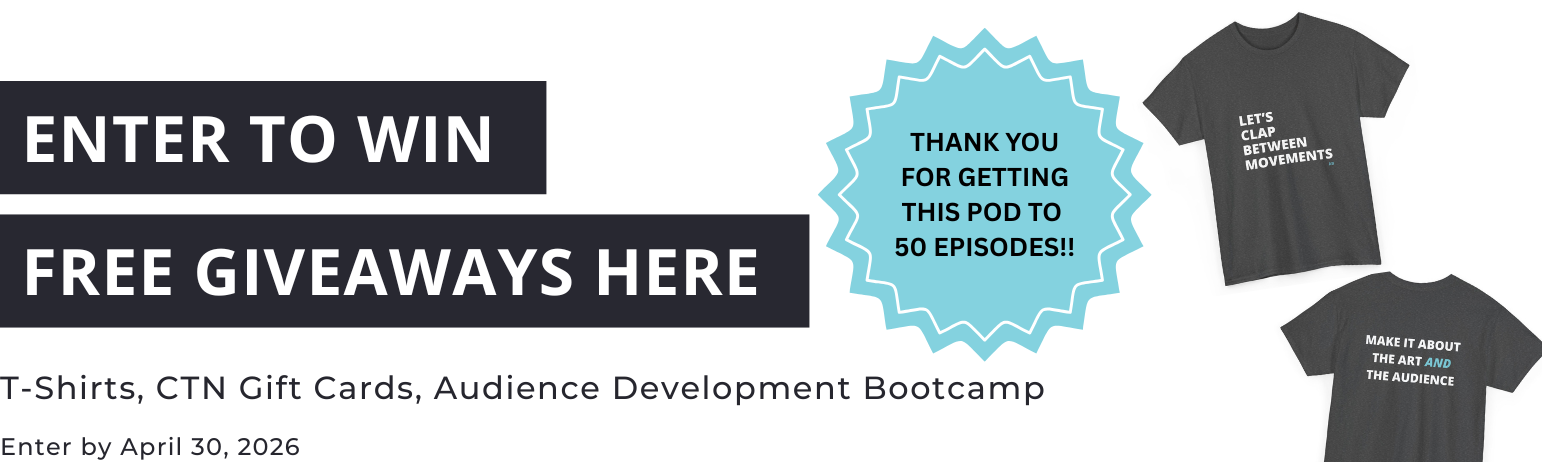
Hey everyone. If you were listening to this episode right when it originally drops, you have two days left to enter to win over $2,000 worth of prizes we are giving away to celebrate hitting our 50th episode of the podcast earlier this season, go to Aubrey Bergauer.com/55 zero. That is for episode 50 to get the details and enter to win before April 30th.
And no matter when you're listening, whether you are on the battlefront of opera or any other artistic discipline, I have something else coming your way I want to tell you about. It's my free Audience Growth masterclass. This is the third year I'm doing it, and it's packed with data, insights and my four step framework to grow not just your audience and subscriber base, but your donor base too.
Last year we had over a thousand people and registration for this year is opening up soon. So get on the waitlist at Aubrey Bergauer.com/masterclass. The work we do serving our institutions is indeed a battle worth fighting, and we need every tool. I'm not going to say a weapon like this analogy is really falling apart, but we need every tool available to help. I cannot wait to share it all with you.
That is Aubrey Bergauer.com/masterclass. That's all for today folks. Thanks so much for listening. And if you like what you heard here, hit that button to follow and subscribe to this podcast. And if you've been around for a few episodes now, would you please consider leaving a quick rating or review?
I really can't thank you enough for your support in this way. To all of you one more time. Thanks again. I'll see you next time on The Offstage Mic. This season of The Offstage Mic is produced by me, Aubrey Bergauer. Our additional production support as well as editing is by Morreale Digital. Our theme music is by Alex Groth. Additional support this season comes from Sandy Kobashi and Johan Treadway.
This is a production of Changing the Narrative. This podcast is brought to you by Morreale Digital. We all want our arts organizations to reach wider audiences and engage our communities, right? Well, a video podcast is a great way to do that. But as I know too well podcasts to take a lot of time and technical skills to do well.
That's why I partnered with Morreale Digital. They handle the technical elements of production, editing and distribution so I can focus on showing up and sharing ideas that matter. To learn how podcasting can help you reach and engage your audience, visit morreale.ca/podcast that'smorreale.ca/podcast or hit the link in the show notes.